

close
Choose Your Site
Global
Social Media

Views: 0 Author: Site Editor Publish Time: 2026-10-15 Origin: Site


Poor coil quality quietly drains profitability from industrial production lines. It drives up scrap rates, creates severe packaging bottlenecks, and compromises end-user safety. You might view uneven cable coiling as a simple aesthetic defect. In reality, it represents a critical mechanical failure. This failure creates gaps and voids between layers, disrupts downstream processing, inflates shipping volumes, and damages your brand reputation. Resolving these persistent defects requires a shift in strategy. You must move beyond temporary manual adjustments. Facilities need systemic mechanical audits. You should specifically evaluate your tension mechanisms and winding synchronization. Integrating automated coiling equipment is often the most effective path forward. This approach eliminates the guesswork from your packaging operations and ensures consistent, repeatable results on the factory floor.
Inconsistent tension and misaligned traversing mechanisms are the primary mechanical drivers of uneven cable coiling.
Implementing a closed-loop cable tension controller is critical for maintaining uniform coil density across varying production speeds.
Transitioning from manual winding to an automatic cable coiling machine reduces human error, eliminates sharp bends, and standardizes packaging dimensions.
Selecting the right cable coiling machine manufacturer requires evaluating their ability to customize equipment for specific cable diameters, stiffness, and facility throughput requirements.
Defining a perfect coil establishes the baseline for quality control on the factory floor. A flawless coil features uniform layer stacking from the inner core to the outer jacket. It maintains optimal tension throughout the entire winding cycle. It holds exact dimensional tolerances, ensuring the inner diameter (ID) and outer diameter (OD) match the packaging specifications perfectly. You will find an absolute absence of gaps or voids between the layers. The traverse mechanism must advance exactly one cable diameter per revolution. If you run a 10mm cable, the pitch must be exactly 10mm. Defective coils fail these basic structural requirements. They bulge, sag, or overlap unpredictably. Operators cannot stack defective coils securely on pallets. This structural failure immediately flags a breakdown in the winding process and requires immediate mechanical intervention.
Coil Quality Metric | Standard Tolerance | Impact of Failure |
|---|---|---|
Traverse Pitch Accuracy | +/- 0.5mm of cable OD | Creates overlapping layers or deep voids between turns. |
Tension Consistency | +/- 5% of setpoint | Causes inner core crushing or outer layer sagging. |
Flange Turnaround Delay | < 0.1 seconds | Builds up massive lumps at the edges of the spool. |
Dimensional Stability | Zero post-winding expansion | Prevents coils from fitting into standard shipping cartons. |
Loose coils wreak havoc on downstream processing and installation. When an electrician or a secondary machine pulls wire from a loose coil, it snags. The loops cross over each other during the unwinding phase. This creates a severe tangle. On an automated assembly line, a snagged pay-off halts the entire machine instantly. You lose valuable production minutes. You risk damaging the wire drawing or cutting equipment. Operators waste time untangling knots instead of monitoring production. This downtime directly reduces daily throughput. It forces production managers to allocate extra labor just to manage feeding issues. Smooth unwinding requires a tightly bound, perfectly layered coil that feeds linearly without catching on itself.
Spatial waste directly inflates your freight costs. Bloated, loosely wound cable coils fail to maintain their structural integrity. They consume significantly more volume than tightly wound counterparts. You can fit fewer defective coils onto a standard shipping pallet. This inefficiency forces you to pay for empty air during transport. Warehouse racks fill up faster. Storage density plummets. When coils collapse during transit, they become hazardous to unload. Forklift operators struggle to handle unstable loads. Standardized, tight coils maximize every square inch of your logistics footprint. They stack cleanly, wrap securely, and survive long-haul transit without deformation.
Physical stress during winding ruins good cables. Excessive localized tension causes immediate internal damage. Overlapping layers crush the segments beneath them. Sharp bends induce micro-bends in delicate fiber optics or snap fine copper strands. These actions place immense stress on the outer extruded jacket. Physical stresses create hidden vulnerabilities. Small holes or microscopic cracks form in the insulation. These defects lead to water ingress when installed in the field. High-voltage cables fail prematurely due to dielectric breakdown. Data cables suffer severe signal degradation. You lose product integrity before the cable even leaves your facility, leading to massive warranty claims and rejected shipments.
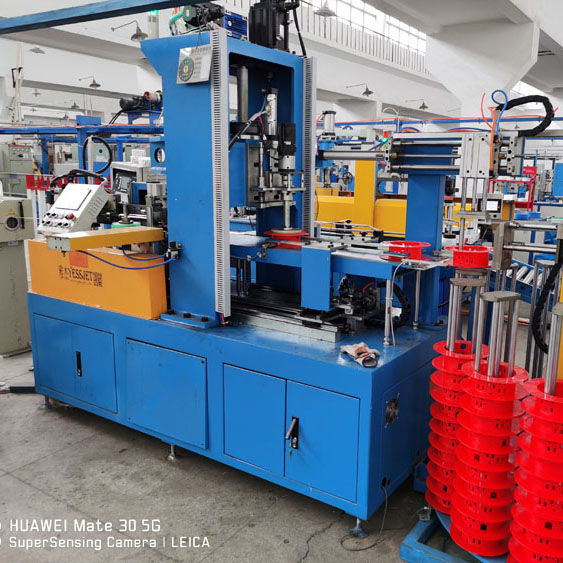
Fluctuations in line speed demand immediate tension adjustments. When speeds change without corresponding tension shifts, slack develops instantly. This slack creates distinct voids between the coil layers. The cable wanders across the spool instead of laying flat. Outdated mechanical friction brakes fail to react quickly enough. They rely on physical wear parts like felt pads or pneumatic calipers that degrade and heat up over time. As they heat up, the friction coefficient drops, and the tension fades. Modern electronic systems monitor tension dynamically. Upgrading to a cable tension controller eliminates these lag times. It uses precision load cells to measure the exact grams of pull force. It guarantees consistent tension from the first meter to the last, regardless of how fast the extruder runs.
Improper calibration of the traversing guide ruins coil geometry. The pitch and stroke must match the exact cable diameter. When misaligned, cables overlap aggressively. They leave wide gaps between turns. They undergo sharp, damaging bends at the flange turnaround points. Mechanical wear exacerbates this issue. Worn U-ring guides allow the cable to vibrate and wander. Bent coiling pins distort the inner core, making it impossible to remove the coil from the tooling. A precision cable coiling head requires strict maintenance. You must verify its alignment regularly to maintain structural integrity.
Measure the exact outer diameter of the extruded cable using digital calipers.
Input the measured diameter into the traverse PLC to set the base pitch.
Jog the machine manually to observe the turnaround point at the left and right flanges.
Adjust the stroke limit switches to ensure the cable does not climb the flange wall.
Inspect the guide rollers for grooving or bearing wear, replacing them if they exhibit any lateral play.
A massive disconnect often exists between extrusion speed and take-up speed. The extruder pushes material at a constant rate. The winder must adjust its RPM continuously as the coil grows in diameter. If synchronization fails, the cable either stretches or goes slack. Faulty dancer accumulators share the blame. They fail to absorb minor speed variations. A sticking dancer arm sends incorrect speed signals to the winder drive via its potentiometer. The PID loop becomes unstable. The winder surges and brakes erratically. You must ensure seamless communication between the main line and the take-up unit, utilizing high-resolution encoders and fast-acting servo drives to keep the speeds locked together.
Internal inconsistencies alter how a cable behaves during winding. Uneven cross-linking changes the flexibility of the jacket. Insulation filler problems create lumps along the cable length. Poor sealing of the metal sheath adds unpredictable rigidity. Concentricity errors in the extruder die create oval-shaped cables instead of perfectly round ones. These defects cause the cable to stack unevenly. The winder expects a perfectly round, uniform product. When it encounters stiff, lumpy, or oval sections, the traverse mechanism cannot lay the cable flat. The resulting coil looks chaotic and feels loose. You must fix the extrusion process before you can expect perfect coiling.
Changes in cable gauge dictate different winding parameters. A thick 4/0 AWG power cable requires massive tension to bend around the core. A thin 24 AWG data cable snaps under that same force. Insulation thickness impacts the traverse pitch. Material rigidity dictates the minimum bending radius. XLPE insulation is notoriously stiff, while standard PVC remains highly flexible. You cannot use a single setup for every product. Operators must adjust the machinery to prevent looseness. Ignoring these variations guarantees defective packaging. You must match the machine settings to the specific physical properties of the cable currently running on the line.
Extruding cables requires massive heat. If the cable does not cool properly in the water trough before coiling, severe problems arise. The plastic jacket shrinks as it reaches room temperature on the spool. This post-coiling shrinkage results in loose, sagging layers. The inner layers crush the core, while the outer layers fall apart. Moisture presents another severe variable. Unsealed cables exposed to humidity experience jacket swelling. Surface friction changes dramatically. A sticky, damp jacket disrupts traverse accuracy. It catches on guide rollers and refuses to slide into place next to the previous wrap. You must control the ambient environment, ensure adequate cooling trough lengths, and utilize air wipes to dry the cable completely before it enters the coiling head.
Automated traverse tracking eliminates uneven layering. Recipe-driven PLC controls remove operator guesswork. You select the cable type on the screen, and the machine adjusts the pitch, stroke, and tension automatically. Voids disappear. An automatic cable coiling machine handles high-mix, low-volume production runs effortlessly. Servo-driven traverse mechanisms provide sub-millimeter accuracy. Quick-changeover tooling allows operators to swap coil dimensions in minutes without using hand tools. You gain massive scalability. The machine maintains perfect geometry regardless of the shift or the operator running the line. It logs production data, monitors fault codes, and ensures every coil meets strict quality standards.
Motorized dancer arms provide real-time tension feedback. Load cells measure the exact pull force applied to the cable in grams or kilograms. The system compares this live data to the programmed setpoint. It adjusts the winder drive instantly via a high-speed PID loop. This closed-loop system prevents wire stretching. It stops insulation deformation. It drastically reduces stress-induced manufacturing defects. You maintain a rock-solid coil structure. The tension remains identical whether the line runs at 10 meters per minute during startup or 500 meters per minute during full production. This dynamic response is impossible to achieve with manual friction brakes.
Securing the coil immediately after winding is non-negotiable. If you wait, the coil loosens and loses its shape. A cable coiling and strapping machine solves this by applying tensioned bands instantly while the coil remains on the tooling. It manages excess cable tails, preventing them from catching on conveyors. You must choose the right strapping material. Nylon (PET) strapping offers high elasticity for softer cables, absorbing impacts during transit. Polypropylene (PP) strapping provides rigid holding power for heavy power cables. Automated strapping locks the perfect geometry in place and eliminates the ergonomic strain of manual tying.
Combining coiling with stretch-film wrapping delivers maximum protection. The film protects against moisture ingress. It prevents structural deformation during transit. An automatic coiling and wrapping machine offers an incredible return on investment. It eliminates manual wrapping labor entirely. It reduces ergonomic hazards for operators who previously bent over to wrap coils by hand. The machine controls the film overlap percentage and the stretch tension, ensuring a tight, uniform seal. You achieve strict compliance with safety standards while delivering a pristine, weather-resistant product to your customers.
Packaging Method | Primary Function | Best Suited For | Environmental Protection |
|---|---|---|---|
Strapping Only | Secures coil shape and manages cable tails | Heavy power cables, internal warehouse storage | Low (No moisture barrier) |
Stretch Wrapping | Encases entire coil in a protective film | Data cables, export shipping, retail display | High (Blocks dust and moisture) |
Integrated (Strap & Wrap) | Maximum structural rigidity and full coverage | High-value cables, long-distance transit | Maximum (Complete seal) |
Assess the manufacturer's engineering portfolio carefully. Do they offer custom coiling heads for specialized cables? Fiber optics require vastly different handling than heavy-duty armored power cables. You need a partner capable of adapting their machinery to your specific product lines. Demand Factory Acceptance Testing (FAT). Use your actual cable samples during this test. Run the machine at maximum line speed. Test the emergency stop recovery. This identifies potential cross-linking or stiffness challenges prior to deployment. A reliable cable coiling machine manufacturer welcomes rigorous testing and will modify the traverse programming to suit your exact materials.
Evaluate the conceptual trade-offs between initial capital expenditure and long-term operational savings. Fully automated lines require a higher upfront investment. However, they deliver massive savings in labor. They slash scrap reduction rates. They increase daily throughput by eliminating manual tying bottlenecks. Look beyond the purchase price. Evaluate the availability of spare parts. Check their localized technical support network. Ask about software update frequency and remote diagnostic capabilities. Machinery that sits idle waiting for parts or a technician destroys your production schedule and erases any initial savings.
Operator resistance presents a major implementation risk. Complex PLC interfaces intimidate staff used to manual winders. Mitigate this by mandating comprehensive on-site training in your procurement contract. Insist on intuitive HMI (Human-Machine Interface) design with visual troubleshooting guides. Integration bottlenecks with existing extrusion lines pose another threat. Mitigate this by conducting thorough pre-installation site audits. Ensure protocol compatibility. Your new winder must communicate flawlessly via PROFINET, EtherNet/IP, or Modbus with your current extruder drives to maintain perfect speed synchronization.
Audit your current scrap rates specifically attributed to coiling defects, tangling issues, and downstream pay-off jams.
Document your exact cable specifications, including minimum bending radii, jacket stiffness, and outer diameter variations.
Upgrade your winding stations with closed-loop tension controllers to eliminate layer gaps and prevent core crushing.
Implement automated securing methods like inline strapping or stretch wrapping to lock in coil integrity before transit.
Schedule a technical site audit with a vetted machinery manufacturer to evaluate your extrusion line synchronization.
A: The primary cause is a mismatch between the traverse speed and the cable diameter. This misalignment, combined with insufficient winding tension, creates distinct gaps between layers. The cable fails to lay flat, resulting in overlapping, bulging, and a structurally compromised coil.
A: It uses motorized dancer arms and precise load cells to dynamically adjust the winder speed. This provides real-time feedback to the drive motor. It ensures constant, uniform tension on the cable regardless of any sudden line speed fluctuations from the extruder.
A: Yes. Modern systems utilize PLCs that store multiple product recipes. Operators simply select the specific cable profile on the screen. The machine automatically adjusts the traverse pitch, stroke, and tension settings for varying gauges and stiffness levels without manual recalibration.
A: Strapping machines apply localized plastic bands to hold the coil's shape and manage excess cable tails. Wrapping machines encase the entire coil in stretch film. Wrapping provides superior environmental protection against moisture, dust, and UV exposure during shipping and storage.
A: You must recalibrate the traverse pitch to match the exact outer diameter of the specific cable. Ensure no sharp bends occur at the turnaround points. Check for mechanical wear on the guide rollers and replace any bent coiling pins.
A: Absolutely. Manufacturing defects like uneven cross-linking or insulation filler inconsistencies change the cable's rigidity. These stiff or lumpy sections make it difficult for standard machinery to lay the cable flat without dynamic, automated tension adjustments.
A: You should upgrade when labor costs for manual packaging exceed automated operational costs. It is also necessary when production speeds outpace your team's ability to manually tie coils, or when end-users demand strict packaging consistency to prevent transit damage.