

close
Choose Your Site
Global
Social Media

Views: 0 Author: Site Editor Publish Time: 2026-10-20 Origin: Site


Manual coil handling creates severe operational bottlenecks in modern extrusion facilities. Relying on human operators to maneuver heavy, shifting cylindrical loads leads to high ergonomic injury rates and chronic labor turnover. Operators struggle to safely position coils that frequently exceed safe lifting thresholds. These manual end-of-line processes throttle upstream extrusion and coiling speeds. When the packaging line cannot keep pace with production, facilities experience inconsistent stack stability, frequent product damage, and compromised shipping integrity.
Automated palletizing serves as a mandatory upgrade for high-throughput facilities looking to eliminate these constraints. Stepping up the level of effectiveness and precision in end-of-line operations requires exact alignment between payload capacities, end-of-arm tooling (EOAT), and facility layout constraints. Deploying the right robotic architecture ensures smooth transitions from the extrusion line to the shipping dock, stabilizing throughput and protecting product quality.
System Integration is Critical: A successful deployment relies on seamless handoffs between upstream automatic cable coiling and strapping systems, coil compaction units, and the palletizing cell.
Tooling Dictates Success: Standard box grippers fail with coils; specialized EOAT (core grippers or heavy-duty mechanical clamps) is required to manage the unique center of gravity and surface friction of cable products, especially pre-wrapped coils.
Footprint vs. Throughput: Single-line and multi-line robotic cells require distinct spatial planning, safety guarding, conveyor routing, and maintenance access mapping before vendor selection.
Robotics over Conventional Systems: While conventional inline palletizers work for uniform boxes, advanced robotic arms or column-type robots are essential for the precision required in cylindrical coil stacking.
Vendor Expertise Matters: Selecting a specialized cable packaging machinery manufacturer reduces integration risks compared to generalist automation integrators.
Relying on manual labor for end-of-line packaging introduces severe operational liabilities on the plant floor. Facilities utilizing outdated cable handling equipment face mounting OSHA compliance risks. Operators wearing heavy personal protective equipment must repeatedly bend over wooden pallets to position 50 to 100 lb coils of wire. The wire shifts inside its packaging, causing the center of gravity to move unpredictably. Lifting these dynamic loads repetitively throughout an eight-hour shift drastically increases worker compensation claims related to rotator cuff tears and lower back musculoskeletal disorders. Operators fatigue quickly, forcing plant managers to rotate staff constantly or slow down production lines to match human endurance limits.
Manual stacking directly limits line speeds. Extrusion lines can run at hundreds of feet per minute, but if the palletizing operator takes a break or slows down from fatigue, the upstream accumulator fills up. The entire line must throttle down. When extrusion lines produce variable coil diameters and weights across multiple shifts, human operators cannot maintain a consistent pace. Bottlenecks at the palletizing station force upstream machinery to idle. You lose thousands of feet of production capacity simply because a human cannot stack fast enough.
Poorly stacked pallets carry a heavy financial impact. Manual placement lacks the precision required for optimal weight distribution. When operators stack coils unevenly, the entire pallet becomes structurally unsound. A forklift picking up an off-center load will cause the coils to shift during transit. Shifting loads tear stretch wrap, gouge wire insulation, crush spools, and ultimately result in rejected shipments at the receiving dock. Quality control suffers when stack stability relies on human judgment rather than programmed precision.
Operational Metric | Manual Palletizing | Automated Robotic Palletizing |
|---|---|---|
Throughput Capacity | 1-3 coils per minute (fatigue dependent) | 5-12+ coils per minute (continuous) |
Ergonomic Injury Risk | High (Repetitive lifting of 50+ lbs) | Zero (Operators moved to supervisory roles) |
Stack Alignment Tolerance | Highly variable (± 2 to 4 inches) | Exact precision (± 1 to 2 millimeters) |
Upstream Line Speed | Throttled to match human pacing | Maximized to extruder capacity |
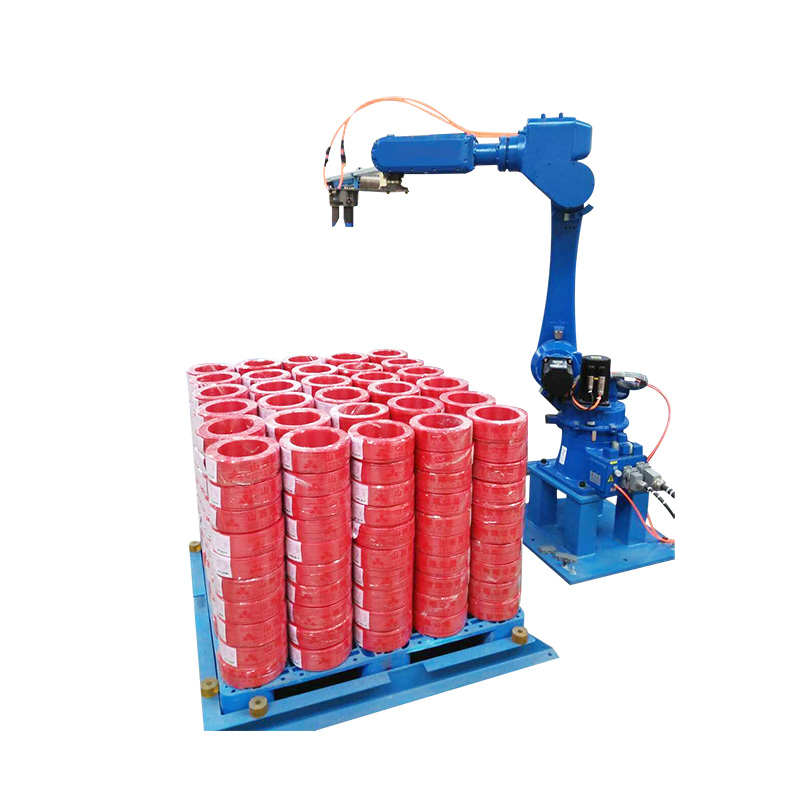
Transitioning to an automatic cable packaging line requires understanding the interconnected machinery that prepares, moves, and secures the product. Each component must communicate flawlessly to maintain continuous operation without jamming or dropping products.
Robotic palletizers require predictable, uniform products. Upstream automatic cable coiling and strapping machines prepare the product for robotic handling. If a coil arrives loose or misshapen, the robot will fail to grip it securely. Coil compaction systems utilize heavy-duty pneumatic or hydraulic plates to compress the wire bundle, ensuring tight, uniform coil dimensions prior to stacking. Consistent strapping with PET or steel bands prevents unspooling during the high-speed robotic transfer. Without tight compaction and secure strapping, the centrifugal force of the robot arm swinging at two meters per second will deform the coil entirely.
Selecting the correct robot palletizer for cable coils depends entirely on your product mix and facility layout. Different kinematic structures offer distinct advantages for cylindrical loads.
Articulated Robotic Arms: 6-axis robots provide superior flexibility for high-speed, multi-line sorting. They execute precise rotational placements, allowing coils to nest perfectly on the pallet. Conventional inline palletizers fail here because they cannot rotate cylindrical loads to optimize pallet density.
Gantry/Cartesian Systems: Facilities handling ultra-heavy payloads benefit from gantry palletizers. These systems operate on an X-Y-Z linear footprint, utilizing overhead tracks to move massive 2,000 lb spools that exceed the payload limits of standard articulated arms.
Column-Type Palletizing Robots: This architecture excels at handling extremely heavy rolled materials. Industrial copper strip coils or steel wire require high vertical reach and rigid stability. Column-type robots lift massive weights without the structural sway or deflection seen in lighter robotic arms.
The EOAT serves as the physical interface between the robot and the product. Standard vacuum grippers used for cardboard boxes will fail instantly on wire coils. You need mechanical engagement. Internal core grippers utilize expanding steel mandrels to secure hollow-center coils from the inside out. This method protects the outer layers of the wire from crushing forces. Conversely, external friction clamps grip the outside diameter of solid spools, requiring precise servo-driven pressure control to avoid deformation.
Palletizing coils that have already passed through an industrial cable wrapping machine presents specific challenges. The EOAT must prevent film puncture while managing slippery surfaces. Specialized high-friction urethane pads and contoured clamp faces distribute pressure evenly across the wrapped surface. Facilities running multiple wire gauges must account for tooling changeover requirements. Automatic tool changers mounted on the robot wrist reduce downtime to seconds when switching between internal core grippers and external clamps.
The palletizing process concludes with load containment. The robotic cell must integrate directly with automated stretch wrappers or strapping systems. Once the robot completes the pallet pattern, heavy-duty chain-driven live roller (CDLR) conveyors transfer the load to the wrapper. This final step secures the heavy, nested coils to the wooden pallet, ensuring safe transport and preventing load shifts during forklift handling and over-the-road shipping.
Engineering a reliable system requires rigorous technical evaluation. You must analyze payload constraints, cycle times, and spatial limitations before drafting equipment specifications or requesting quotes.
Calculating true payload requirements prevents catastrophic system failures and premature servo motor burnout. You cannot simply match the robot's maximum payload to your heaviest coil. True payload equals the maximum coil weight plus the EOAT weight, multiplied by a safety factor (typically 1.2 to 1.5) to account for dynamic forces during high-speed rotation. An EOAT designed to lift a 100 lb coil might weigh 200 lbs itself due to the steel frame, pneumatic cylinders, and valve banks.
Layer weight accumulation presents a distinct engineering challenge. As coils stack, the cumulative weight stresses the bottom layers and the pallet structure. Coil nesting optimizes space but concentrates weight in specific zones. A pallet holding four layers of four coils can easily exceed 1,600 lbs. You must verify that the wooden or plastic pallets can withstand the total dynamic load during forklift transport without splintering.
Parameter | Light Duty (Data Cables) | Medium Duty (Building Wire) | Heavy Duty (Industrial Power) |
|---|---|---|---|
Typical Coil Weight | 10 - 50 lbs | 50 - 200 lbs | 200 - 1500+ lbs |
Recommended Robot Type | 4-Axis SCARA or Light 6-Axis | Standard 6-Axis Articulated | Heavy-Duty 6-Axis or Gantry |
Preferred EOAT | Pneumatic Core Gripper | Servo-Driven External Clamp | Heavy-Duty Mechanical Mandrel |
Pallet Integrity Risk | Low (Standard Pallets Sufficient) | Moderate (Requires Grade A Pallets) | High (Requires Reinforced Skids) |
Throughput requirements dictate the system architecture. Single-line palletizers dedicate one robot to one high-speed extrusion line. This setup simplifies programming and minimizes conveyor routing. However, facilities with multiple slower extrusion lines benefit from multi-line centralized palletizing. One high-speed robot handles products from three or four lines simultaneously.
Multi-line setups demand extensive buffering conveyor requirements. When the robot services Line A, products from Line B and C must accumulate safely without jamming. You must calculate the maximum accumulation time based on the robot's cycle time and the extrusion line's output rate to size the zero-pressure accumulation zones correctly.
Facility layout dictates the feasibility of any automation project. You must measure ceiling height to ensure the robot has sufficient vertical clearance for its maximum reach envelope, especially when stacking the top layer of a tall pallet. The turning radius of the robot arm requires strict safety zoning. Forklift access for pallet removal must feature clear, unobstructed travel paths to prevent traffic bottlenecks.
Engineers frequently overlook the need for dedicated operator and maintenance access zones. If a technician cannot easily reach the robot base or the EOAT for routine lubrication, maintenance gets deferred. Deferred maintenance leads to unplanned downtime. Map out safety gates, light curtains, and access panels during the initial 3D CAD layout phase.
Deploying robotics in a live production environment involves navigating product variability, software integration hurdles, and strict safety compliance mandates. Ignoring these realities leads to delayed launches and budget overruns.
Automating a line with high SKU proliferation introduces significant risk. Varying wire gauges, coil densities, diameters, and weights confuse rigid automation systems. If a robot expects a 20-inch diameter coil but receives a 24-inch coil, the EOAT will crash into the product, causing damage and triggering a fault.
Mitigate this risk by integrating 2D or 3D vision systems and barcode scanners upstream of the picking zone. These sensors identify the specific SKU and trigger automated recipe selection in the PLC. The robot adjusts its grip pressure, approach angle, and dynamic stacking patterns on the fly, ensuring high-precision repeatability regardless of the product mix coming down the line.
Hardware is only half the equation. Integrating the palletizer's PLC with existing Warehouse Management Systems (WMS) or Manufacturing Execution Systems (MES) creates complex data handoffs. The palletizer must report exactly how many coils are on each pallet, tie that data to a specific lot number, and trigger the WMS to generate a shipping label. Hardcoding these handoffs via Ethernet/IP or Profinet requires experienced controls engineers to map the data registers accurately.
Robotic workcells demand mandatory safety infrastructure. You cannot operate a high-speed industrial robot without hard wire-mesh fencing securing the perimeter. Light curtains protect the infeed and outfeed conveyor openings, instantly halting the robot if an operator breaches the plane. Safety interlocks on access gates and laser area scanners within the cell ensure the system drops power to the servos while personnel perform maintenance or clear jams.
Partnering with a specialized cable packaging machinery manufacturer drastically reduces integration risks compared to hiring a generalist automation integrator. Generalists often underestimate the physics of handling heavy, shifting cylindrical loads.
Evaluate a vendor's specific experience with wire and cable products. Ask for video case studies demonstrating their success with heavy cylindrical loads, coil compaction mechanisms, and wrapped products. Standard corrugated box palletizing experience does not translate to cable handling. The vendor must understand how wire tension, coil memory, and surface friction affect robotic gripping.
Never accept delivery of a system without a rigorous Factory Acceptance Testing (FAT) protocol. You must travel to the vendor's facility and run these non-negotiable tests using your actual product samples:
Maximum payload stress tests using your heaviest, most awkward SKUs.
Drop-recovery protocols to verify how the system handles a dropped coil or a missed pick without requiring a full manual reset.
Continuous runtime minimums (e.g., 8 to 24 hours of uninterrupted operation) to prove software stability and thermal management of the servo drives.
Tooling changeover timing tests to ensure operators can swap grippers within the specified time limits.
Hardware eventually requires support. Evaluate the vendor's post-installation capabilities. Local technician availability minimizes downtime during critical mechanical failures. Remote diagnostic capabilities via a secure VPN allow the vendor's controls engineers to log into your PLC and troubleshoot software bugs without booking a flight. Demand guaranteed response times for spare parts delivery in your Service Level Agreement (SLA).
Automating cable coil palletizing represents a high-ROI initiative for facilities constrained by labor shortages and manual throughput limits. Success requires precise engineering of the EOAT, robust coil compaction, and smooth upstream integration. When executed correctly, robotic palletizing eliminates ergonomic injuries, stabilizes line speeds, and guarantees perfect stack quality for shipping.
Use a step-by-step decision framework to shortlist solutions. First, audit your maximum coil weights and dimensions. Second, measure available floor space, ceiling heights, and forklift access routes. Third, determine whether a single-line or multi-line architecture best suits your production flow. Finally, vet specialized vendors who understand the unique physics of cylindrical loads.
Take these immediate next steps to advance your automation project:
Conduct an internal time-study on your current manual packaging line to quantify exact throughput bottlenecks.
Gather accurate 3D CAD models of your facility layout to identify structural columns and access constraints.
Compile a comprehensive list of all SKUs, noting dimensions, weights, and packaging materials.
Draft a Request for Quotation (RFQ) detailing your required cycle times and payload limits.
A: Heavy-duty 6-axis articulated arms comfortably handle 500kg to 1000kg. For extreme applications involving industrial copper strip or heavy steel wire coils, gantry systems and column-type palletizing robots exceed 2000kg. These specialized units provide rigid stability for massive cylindrical loads, preventing the structural deflection common in lighter robotic arms during high-speed transfers.
A: Integration relies on precise conveyor handoffs and PLC communication. The upstream machine signals the robot when a coil is ready. Coil compaction units ensure uniform dimensions. Tight strapping prevents the wire from deforming or unspooling when subjected to the clamping force of the robot's end-of-arm tooling.
A: The optimal tooling depends on the coil structure. Internal core grippers utilizing expanding mandrels work best for hollow-center coils, protecting the outer wire layers. External mechanical clamps handle solid spools. Pre-wrapped products require specialized friction pads to grip securely without puncturing the protective stretch film.
A: Space requirements vary widely based on configuration. A single-line cell might require a 15x15 foot footprint. You must factor in the robot base, infeed accumulation conveyors, automatic pallet dispensers, mandatory safety fencing, maintenance access zones, and outfeed wrapping stations. These elements significantly expand the total required floor area.
A: Yes, multi-line centralized palletizing utilizes one high-speed robot to service several extrusion lines simultaneously. This architecture requires extensive accumulation conveyors to buffer products. Vision systems or barcode scanners identify incoming SKUs, allowing the PLC to route different products to distinct pallets using dynamic stacking recipes.
A: Conventional inline palletizers are designed for uniform, rigid boxes. Robotic arms offer superior precision and rotational flexibility. They rotate cylindrical coils to nest them perfectly on the pallet, optimizing space and stability. Robotics also utilize specialized grippers necessary for handling non-uniform or shifting wire loads safely.
A: Facilities typically see a payback period of 18 to 36 months. Return factors include the reallocation of manual labor to higher-value tasks, a drastic reduction in worker compensation claims from lifting injuries, increased overall line speed, and a reduction in product damage during transit due to improved stack stability.