

close
Choose Your Site
Global
Social Media

Views: 0 Author: Site Editor Publish Time: 2026-06-23 Origin: Site


Industrial procurement teams often confuse the physical formation of a coil and its protective packaging. Overlapping terminology across supplier catalogs frequently leads to misaligned capital expenditure. You might buy the wrong machine and severely disrupt your facility layout. Investing in the wrong equipment either creates a new bottleneck in production or leaves finished goods vulnerable during transit. Facilities must pinpoint exactly where delays occur to apply the correct mechanical solution. Your final choice depends entirely on whether your operation struggles most frequently regarding winding precision, packaging throughput, or high manual labor constraints. We will explore the mechanical boundaries dividing production from packaging. You will learn how to evaluate tension control capabilities versus load stability requirements. Finally, we will guide you through selecting dedicated equipment or an integrated system based on floor space and cycle times.
Distinct Functions: A Coiling Machine takes linear material and forms the physical coil; a Coil Wrapping Machine applies protective packaging (film/paper) around an already formed coil.
Identify the Bottleneck: Upgrading a coiling machine solves wire tension and production speed issues; adding a wrapper solves transit damage and high packaging labor costs.
Hybrid Solutions Exist: For high-throughput facilities, an Electric Automatic Cable Wire Winding Packing Machine integrates both processes, though it requires specific volume thresholds to justify the ROI.
Evaluation Lens: Final equipment selection should hinge on cycle time matching, floor space footprint, and specific material handling compliance.
Coiling represents a fundamental manufacturing step. It transforms raw, continuous linear materials into manageable geometric forms. Extruded wire, heavy-duty cable, or flexible pipe exits the upstream line at high velocities. The machine catches this material and winds it uniformly into a predetermined inner and outer diameter. Mechanics rely heavily on precise traverse movements. The equipment must distribute the material evenly across the spool or mandrel. Uneven distribution creates high spots. High spots lead to tangles during the end-user unspooling process. You must view this stage strictly as production. It directly impacts the physical integrity of the final good.
Wrapping serves as a critical end-of-line logistics step. It begins only after the coil assumes its final physical shape. A Coil Wrapping Machine passes protective media through the hollow center, or "eye," of the coil. Common media includes stretch film, volatile corrosion inhibitor (VCI) paper, or woven fabric. A rotating ring drives the material shuttle in a continuous circular motion. The coil itself rotates slowly on support rollers. This synchronized movement creates a tight, overlapping seal. The primary goal is protection. It shields the product from dust, moisture, and abrasive friction during transport. It does not alter the product form.
Buyers frequently stumble over overlapping industry terms. Many original equipment manufacturers (OEMs) sell both types of machinery. Supplier catalogs often list them side-by-side under general "coil handling" categories. Terms like "spooler," "winder," "wrapper," and "packer" get mixed in marketing collateral. A facility manager might search for a wrapping solution but accidentally request quotes for a winding machine. You must maintain strict internal definitions. Always separate the equipment forming the shape from the equipment securing the load.
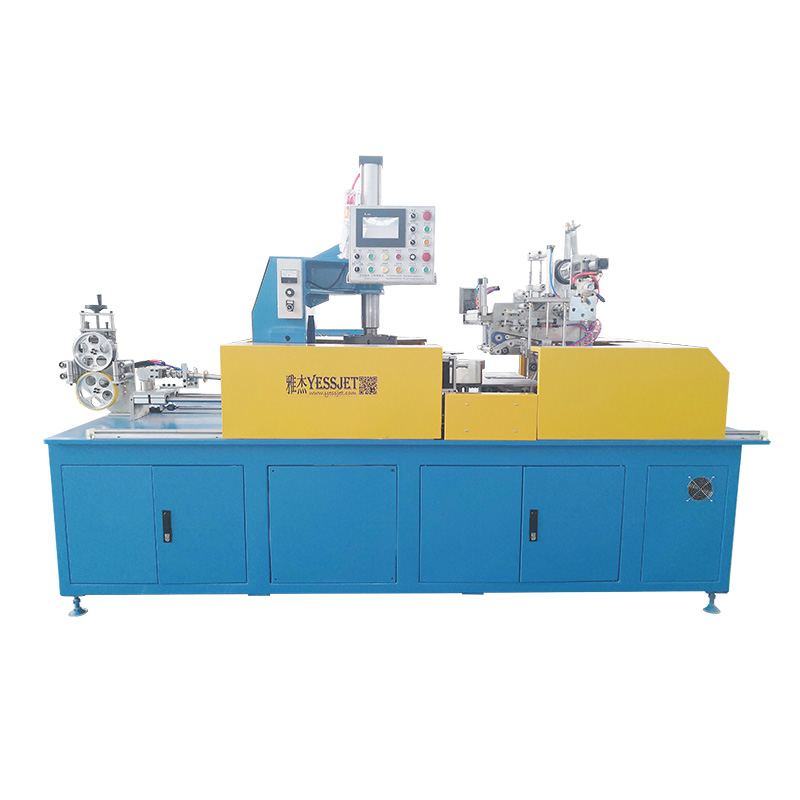
A high-performance Coiling Machine must deliver flawless lay-winding. Every layer must rest perfectly beside the previous one. Accurate length counting is equally vital. Customers reject shipments missing even a few meters of cable. Preventing material deformation stands as another core criterion. Excessive pull stretches copper wire. Inadequate support kinks hollow plastic pipes. You need a system capable of managing these variables simultaneously without constant operator intervention.
Consistent Pitch Control: The traverse mechanism adjusts instantly to material diameter variations.
Accurate Metreage: Encoders measure length precisely before triggering the automatic cutting shears.
Defect Prevention: Soft-start motors prevent sudden jerks from damaging delicate fibre optics.
Modern extrusion lines run exceptionally fast. Your coiler must match this upstream speed perfectly. Mechanical integration relies on tension dancers and motorized pay-offs. A tension dancer acts as a mechanical buffer. It uses weighted pulleys to absorb slack or provide extra feed when line speeds fluctuate. If the extruder surges, the dancer arm drops. The machine controller senses this movement. It speeds up the winding motor instantly. Poor synchronization causes catastrophic line crashes. Scrap rates skyrocket when these systems fail to communicate.
Direct your capital here if your current winding process chokes the upstream extrusion line. Semi-automated or manual winding often creates messy, bulging coils. These visual defects harm your brand reputation. Inaccurate length measurements destroy profit margins through material giveaway. If operators constantly stop the main extruder to untangle the winding spool, your bottleneck sits squarely in production. Upgrading this equipment restores baseline manufacturing throughput.
Packaging equipment must guarantee load stability. It creates a tight, moisture-proof, and secure package. The wrapping material binds the individual loops of the coil together. This prevents unspooling during forklift transfer. Proper packaging blocks oxidation on bare metal wires. It prevents physical abrasions when coils rub against truck walls during highway shipping. Consistently passing standardized transit vibration tests indicates a successful wrapping deployment.
Manual wrapping poses severe ergonomic risks. Workers must repeatedly bend and thread film through the coil eye. This awkward motion causes chronic back and shoulder injuries. Manual application also guarantees inconsistent tension. One operator might pull the film too tight, crushing the product. Another might leave it loose, allowing the coil to unravel. Automating this step solves both issues. A machine applies exact stretch tension. It maximizes film yield. You significantly reduce consumable waste and virtually eliminate operator injury risks.
Evaluation Metric | Manual Wrapping | Automated Wrapping |
|---|---|---|
Ergonomic Risk | High (Repetitive strain, bending) | Low (Operator manages controls only) |
Film Yield | Poor (Inconsistent manual stretching) | Excellent (Pre-stretch carriages maximize yield) |
Cycle Time | 3-5 minutes per coil | 30-60 seconds per coil |
Load Consistency | Varies drastically by operator fatigue | Identical tension on every cycle |
Allocate capital toward end-of-line packaging if transit damage plagues your operation. High instances of rejected shipments due to moisture ingress require immediate wrapping automation. Review your labor distribution. If manual packaging consumes more hours than product assembly, you have a packaging bottleneck. Reallocating those workers to higher-value tasks dramatically improves facility output.
High-volume facilities frequently outgrow standalone machines. The Electric Automatic Cable Wire Winding Packing Machine represents the ultimate end-of-line integration. It functions as a continuous automated line. Raw cable enters the system. The machine cuts the exact length. It coils the material tightly. Integrated strapping heads secure the form. Finally, the built-in wrapping ring applies protective film. The finished, shipment-ready product discharges automatically onto a conveyor.
Integration physically eliminates intermediate material handling. You no longer need a forklift to move a bare coil from the winder to the wrapper. This drastically reduces overall cycle times. Floor space footprint shrinks because you eliminate the staging buffer zones between two separate machines. Factory safety improves substantially. Fewer forklift movements mean fewer collision risks. The seamless transfer keeps the coil fully supported at all times. It cannot warp or collapse before packaging.
This hybrid approach demands highly standardized product dimensions. Integrated lines struggle to accommodate massive changes in coil sizes without lengthy tooling changeovers. You must also consider the "single point of failure" risk. If the wrapping mechanism jams, the entire line halts. The upstream coiling process cannot continue. The main extrusion line might even need to pause. You must implement robust preventative maintenance schedules to mitigate this risk. Proper sensor cleaning and lubrication become mandatory daily tasks.
You cannot select the right equipment without baseline data. Conduct a thorough time-motion audit of your current operation. Measure exact cycle times. Use a stopwatch to track material from the extruder exit to the shipping pallet.
Measure Winding Time: Track how long it takes to form the coil completely.
Measure Transfer Time: Record the duration required to move the bare coil to the packaging zone.
Measure Wrapping Time: Clock the manual or semi-automated packaging process.
Identify Idle Waiting: Note whenever the extruder slows down to let packaging catch up.
The longest duration dictates your true bottleneck. Fix the longest step first.
Examine the hidden costs of manual operations. Manual wrapping generates high rates of repetitive strain injury (RSI) claims. Worker fatigue slows down production at the end of every shift. Manual coiling requires operators to handle rapidly moving heavy materials. Evaluate your incident logs. Frequent minor hand injuries around the winder indicate an urgent need for coiling automation. Back injuries in the shipping department point directly to a manual wrapping crisis.
Audit Area | Symptom Observed | Recommended Focus |
|---|---|---|
Speed matching | Extruder frequently paused | Upgrade Coiling Equipment |
Product transit | Coils arrive scratched/damp | Upgrade Wrapping Equipment |
Labor allocation | 4+ operators per line handling | Consider Integrated Hybrid Line |
Space utilization | Aisles blocked by WIP inventory | Eliminate transfer buffer zones |
Assess your internal forklift traffic. Moving raw, unwrapped coils across a busy facility poses severe risks. Dropping an unwrapped coil often destroys it entirely. Dedicated wrapping zones require massive square footage for staging queues. If floor space is extremely tight, an integrated line offers the best spatial efficiency. If you have sprawling logistics bays, keeping the wrapper physically separated from the noisy extrusion floor might make more sense.
Always ask vendors about future integration capabilities. Do not buy a dead-end machine. Ask specific operational questions during the vetting process. Can the wrapper accept an automated conveyor feed later? Does the coiler's control system support open communication protocols like OPC UA? Ensure the equipment can scale as your production volume increases. Standardized PLC architectures allow easier upgrades when you eventually connect these machines to a factory execution system.
Recognize that equipment selection is not an "either/or" battle, but a logical sequence of sequential operations.
Start your procurement process with a rigorous time-motion audit to expose the true production bottleneck.
Address winding issues to improve line speed; address packaging issues to eliminate transit damage.
Determine if an integrated packing line yields the fastest performance based on your standard wire gauges and daily volume.
Consult deeply with automation integration engineers before issuing your final request for proposal (RFP).
A: No. Wrapping machines possess strict mechanical limits. They do not pull, spool, or form raw linear material. They only apply protective film or paper around a coil that has already been formed by a dedicated winder.
A: Most facilities see a return on investment within 12 to 18 months. This timeline assumes a standard two-shift operation. The rapid return stems directly from reallocating manual packaging labor and drastically reducing stretch film waste through precise tension control.
A: No. Integrated machines have strict dimensional limits. Switching between vastly different wire gauges requires significant tooling changeovers. Be highly skeptical of any manufacturer claiming a single integrated line can handle every conceivable wire size without disruption.